 IranRadar24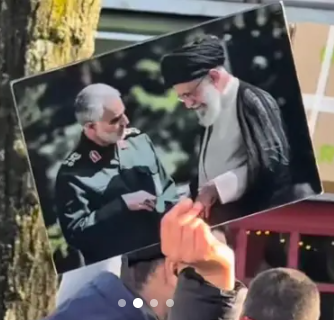
Photo: Sofie Löwenmark
This article is a translation – Read original Article (Swedish)
Iranians celebrate – but Palestinian activists mourn the tyrant.
At the Palestine demonstration in Gothenburg, the speaker paid tribute to Ayatollah Ali Khamenei.
In front of the statue of Gustavus Adolphus in the square of the same name in Gothenburg, an easel stands. On it rests a large portrait of Ali Khamenei, Iran’s brutal ayatollah.
The Palestine movement’s recurring Sunday demonstration developed last weekend into a tribute to the Iranian regime. The participants are a motley collection of Islamists, communists and post-colonial left-wing activists.
The flag of the theocracy was visible, of course, but also lots of Hezbollah flags. And, perhaps most telling: the flag of the hardline Islamic Revolutionary Guard Corps. An organization whose task is to protect the regime and crush any attempt at protest or uprising. What brutality means in practice recently became clear when over 30,000 unarmed Iranians were cold-bloodedly mowed down.
Many demonstrators in the square carried their own pictures of the late dictator. A woman who was entrusted with giving a speech grabbed the microphone to express her grief over “our beloved leader”. She took the opportunity to mock the more than 2,000 exiled Iranians who were simultaneously celebrating Ali Khamenei’s death with music and dance at Götaplatsen, just a few blocks away.
Anyone who has followed the movement is not surprised. Social media shows that the entire leadership and a large part of the returning participants have consistently praised the Iranian regime. The Palestine movement in Gothenburg in particular has long distinguished itself as more openly extreme than in other Swedish cities.
But even high-profile Palestine activists in other Swedish cities show support for the Islamic republic. Some express it mildly, others devote themselves to glorifying the oppressors. If you zoom out, it looks the same in many Western cities.
In parts of Western activism, hatred of Israel seems to have become so strong that it turns a blind eye to the forces it allies itself with: Islamist militias, theocratic dictatorships, and regimes that systematically murder their own citizens.
It is difficult to imagine that the activists of the Palestine movement themselves would choose to live under the brutal oppression of the Islamic regime. But here the common disgust with Israel, the US and the West – and the fear of losing the unifying link of the axis of resistance – clearly outweighs solidarity with the freedom-hungry Iranian people.
There is also a religious dimension. The pro-Palestinian movement is clearly pro-Islamic and most of the Muslims who participate are Sunni. Despite the historical opposition between Sunni and Shia, the Iranian regime has managed to gather a broad coalition of Islamist actors through its clear hatred of Jews and Israel.
In Muslim theological and political forums on social media, it is precisely the religious aspect that is highlighted. Expressen recently revealed how several Swedish Shia Muslim congregations are mourning the Ayatollah.
At the same time, many of the regime’s harshest critics in the Iranian diaspora, like many protesters in Iran, advocate secularization. During the protests, Iranians have described how they experience the regime as an Islamic occupying power.
If the regime falls, it would not only pose a threat to its terrorist allies; it would also be a severe blow to religion as a political tool of power in the region.
In parts of Western activism, hatred of Israel seems to have become so strong that people turn a blind eye to the forces they are allied with: Islamist militias, theocratic dictatorships and regimes that systematically murder their own citizens.
Sometimes they even praise them.
That is why the scene in Gothenburg was so telling. While thousands of Iranians celebrated a possible end to decades of brutal oppression, others stood a few blocks away and held up portraits of the man who personifies it.
… Read original Article (Swedish)
🔔 This is a column by an independent editorial columnist. Expressen’s political stance is liberal.
Sofie Löwenmark is a freelance columnist on Expressen’s editorial page. Read more of her texts here.